When AI Collapses the Middle
Table of Contents
Middle management exists because coordination is expensive. An executive cannot talk to two thousand people; a line worker cannot see the three quarters ahead of their queue. The middle exists to translate, schedule, escalate, and aggregate — to convert strategy into tasks on the way down and signal into summaries on the way up. The layer is not lazy. It is a compression algorithm the firm runs on itself because humans are the only thing in the building that can do it.
Compression algorithms get replaced when something cheaper arrives. Something cheaper has arrived.
What the middle actually does
If you decompose middle-management work honestly, most of it is not judgment. It is reading, summarizing, tracking, routing, and re-expressing. A manager spends large fractions of the day on the interfaces between other people’s work: did the thing ship, what does the numbers say this week, what is blocking the thing that should have shipped, who else needs to know. This is exactly the category of work that current systems can do well. Not well enough to replace a senior leader making a judgment call on a partnership. Well enough to replace the four-hour meeting-and-status-summary workflow that consumes most of the L6’s week.
What remains after you subtract that is a smaller set of genuinely high-leverage activities: real judgment under ambiguity, relationship capital that crosses organizational boundaries, the ability to hire and fire, and the ability to hold a narrative that motivates people in a downturn. These do not compress as well. A firm that understands this does not fire its middle; it keeps the fraction of the middle that does these things and stops paying for the rest.
Why the org chart stops being the right picture
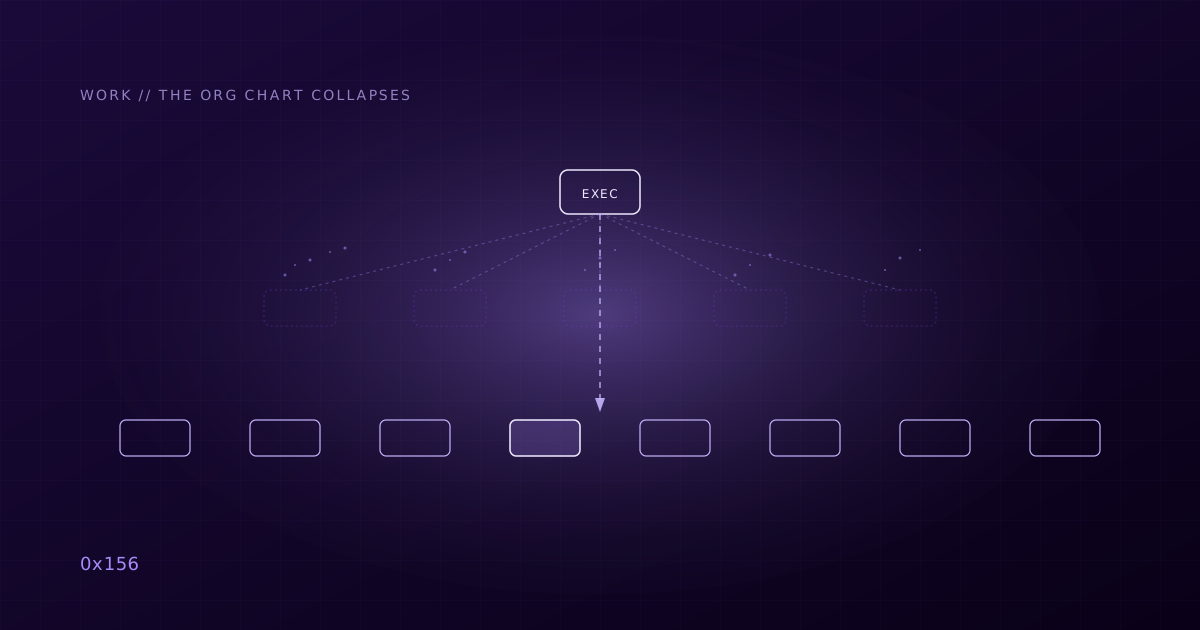
If you accept that premise, the conventional pyramid stops describing the firm. What replaces it is not a flat organization — “flat” is a myth in any firm above about eighty people, because coordination does not become optional at scale — but a structure in which the coordination layer is mostly machinery rather than people. Executives talk to systems, systems talk to contributors, contributors talk back to systems, and a much smaller human layer intermediates where judgment, trust, or relationship is actually load-bearing.
This is not a theoretical prediction. It is already the operating model of the most aggressive adopters, and the details are already legible. Span of control, the ratio of direct reports a manager can handle, is already creeping up in functions where AI systems absorb the routine parts of oversight. Career ladders are starting to acknowledge that the Staff IC path and the Manager path have converged: both roles require the ability to orchestrate systems that then orchestrate work. The distinction between them is becoming one of emphasis, not of kind.
What this does to careers
The consequences for individual knowledge workers are uncomfortable but predictable. The middle was an escalator. You started as an analyst, became a manager, became a senior manager, became a director. At each step the work got a little less technical and a little more about coordination. The escalator is not disappearing, but it is getting narrower — there are fewer rungs in the middle because the firm needs fewer people doing what those rungs did. The people who occupy the remaining rungs will be paid more and be harder to become.
The people displaced from the middle do not vanish from the economy. Some move sideways into individual-contributor roles that are now more valuable because a single senior practitioner can do what a team used to. Some move outward into smaller firms that never had a middle to begin with. Some will spend a decade as the last generation trained on an assumption — “build the skills to become a manager” — that the firms they are trying to join stopped needing.
What to watch for
The signal that this has actually happened will not be layoffs at any one company. It will be a steady divergence between revenue per employee and the shape of job postings. When the same firm can grow revenue by 30% while growing headcount by 5%, and the growth in headcount is concentrated in ICs and executives with almost nothing in the middle, the transition is complete. We are already seeing this in the public filings of the most aggressive adopters. It is not yet an industry-wide phenomenon. It will be within five years.
What replaces the middle is not magic. It is software. The firm that takes this seriously will treat internal tooling the way it used to treat org design: as the single highest-leverage investment, because the tooling is now the thing that does the work the middle used to do.