Trust When Anyone Can Fake Anything
Table of Contents
For most of human history, trust has been subsidised by scarcity. Forging a signature was expensive. Producing a convincing video of someone was prohibitively so. Pretending to be someone on the phone was possible but required skill. These costs were not security features in the formal sense, but they functioned as one: the sheer effort required to deceive meant that most communications were roughly as authentic as they appeared.
Generative models have collapsed those costs. Voice cloning is minutes. Video is a prompt. Writing in someone’s style is a few examples. Synthesizing a coherent identity across dozens of channels is within reach of a motivated individual with a laptop. The subsidy that scarcity provided to trust is gone.
This is not a crisis of AI. It is a crisis of the assumptions a generation of social infrastructure was built on. Those assumptions are becoming expensive to hold, and they are being revised in ways that the discourse has not fully registered.
What actually gets harder
The first thing to get more difficult is asynchronous trust. A decade ago, an email from your CFO asking you to wire a substantial sum was a low-probability event that nevertheless might be real. Today the base rate of such emails that are authentic is meaningfully lower. Not because CFOs send fewer of them, but because adversaries send more — and because the costs of producing a convincing one have fallen to the point where producing thousands is tractable.
Voice on the phone is next. Voice used to be a reliable-enough signal of identity that many authentication systems relied on it implicitly. A voice-clone of a family member asking for help in a crisis is already a common scam category. The ability to verify a voice by listening to it is degraded. The ability to verify a voice using the voice alone, without external context, is gone.
Video is the one most people over-index on because it is emotionally striking. I think it is actually the least worrying of the three, because the cost of generating convincing video remains high relative to the other two, and because video is typically consumed in a context — a news broadcast, a verified platform — that supplies some of the missing provenance. The more subtle degradation is in casual video — a clip sent over messaging, a snippet in a thread — which most people have not yet learned to discount.
What replaces the lost signal
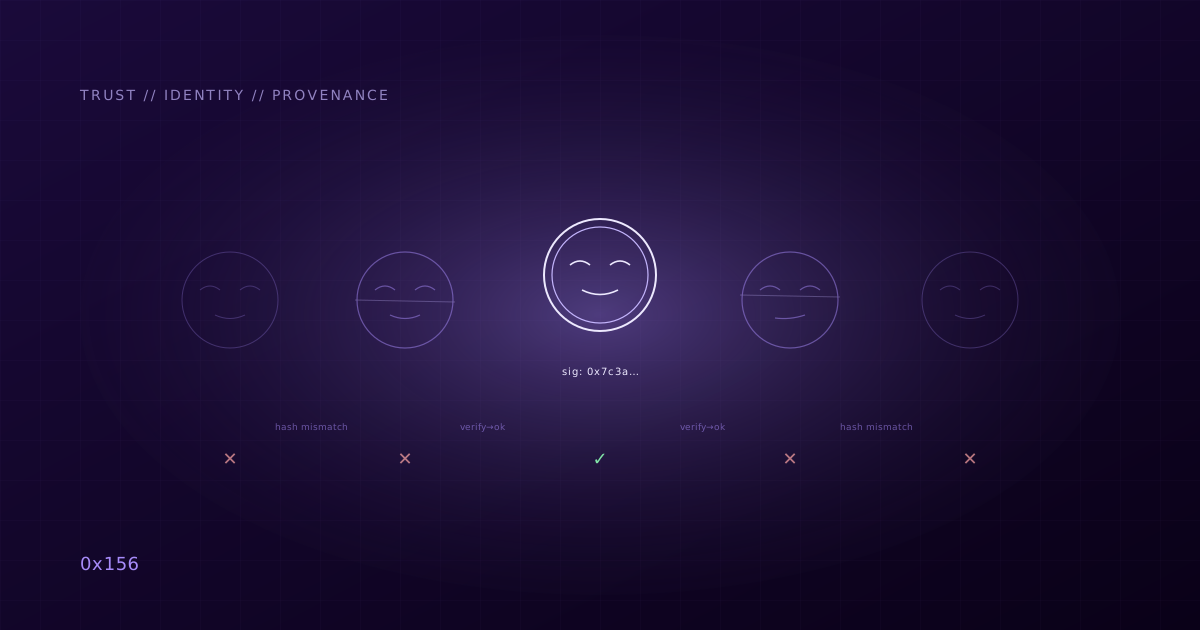
The naive response is cryptographic: every content item gets a provenance signature, identity gets a verified chain, platforms enforce authentication, problem solved. I used to think some version of this would work. I no longer do.
Cryptographic provenance solves verification for a small number of users who care about it in a small number of high-stakes contexts. It does not solve it for the large majority who do not carry signed keys, do not understand chains of custody, and will never inspect a signature. For the mass case, verification happens at a different layer entirely: reputation, relationship, and context.
This is a return, in some sense, to a pre-industrial model of trust. For most of history, people trusted people they knew, institutions with continuous reputations, and communications that came through channels with high setup costs. The industrial and digital ages lowered those setup costs and allowed us to trust strangers and documents more broadly. The generative age is raising the setup costs again — not the cost of producing content, which is now near zero, but the cost of producing content whose authenticity you actually believe.
Practically, this means people will trust a narrower set of sources. Institutions with long reputational capital will be the winners. So will interpersonal networks that verify via out-of-band channels. So will platforms that invest in provenance infrastructure for their own content and aggressively police impersonation. Losers will be the broad middle: content floating free of context, attributed to someone neither you nor your network knows personally.
What this does to public life
The downstream effects on public life are going to be uncomfortable.
Public discourse depends on a shared baseline of what events actually occurred. That baseline has always been contested at the margins, but the margin is growing. In a world where any claim can be accompanied by convincing fabricated evidence, and any inconvenient fact can be dismissed as fabricated, the equilibrium is not mutual skepticism — skepticism is hard work. The equilibrium is that people trust the sources their existing priors predispose them toward, because those sources feel right, and they distrust everything else as a matter of course.
This is already happening. It will accelerate. The solutions are not technological. They are institutional: news organizations that invest in verifiability and take reputational hits for getting it wrong, platforms that privilege sources with continuous accountability, courts that adjust evidentiary standards to account for the new landscape. Each of these is a slow, boring, expensive response to a fast, interesting, cheap problem, and each of them is the only kind of response that will work.
The individual posture
At the individual level, the implications are small but not negligible. You will end up trusting fewer sources, more deeply, with more verification. You will develop small rituals — callbacks on critical communications, pre-shared code words for family in distress, skepticism toward urgent requests. These will feel paranoid for about two years and then feel normal.
Anyone who tells you that a clever technical fix will make these rituals unnecessary is selling something. What is shifting is not solvable at the layer of technology. It is a restoration of something closer to the natural cost of trust, after a century-long subsidy provided by the high cost of fabrication. The subsidy is gone. What replaces it is the old answer: trust people and institutions with continuous, verifiable skin in the game, and be sparing with everyone else.